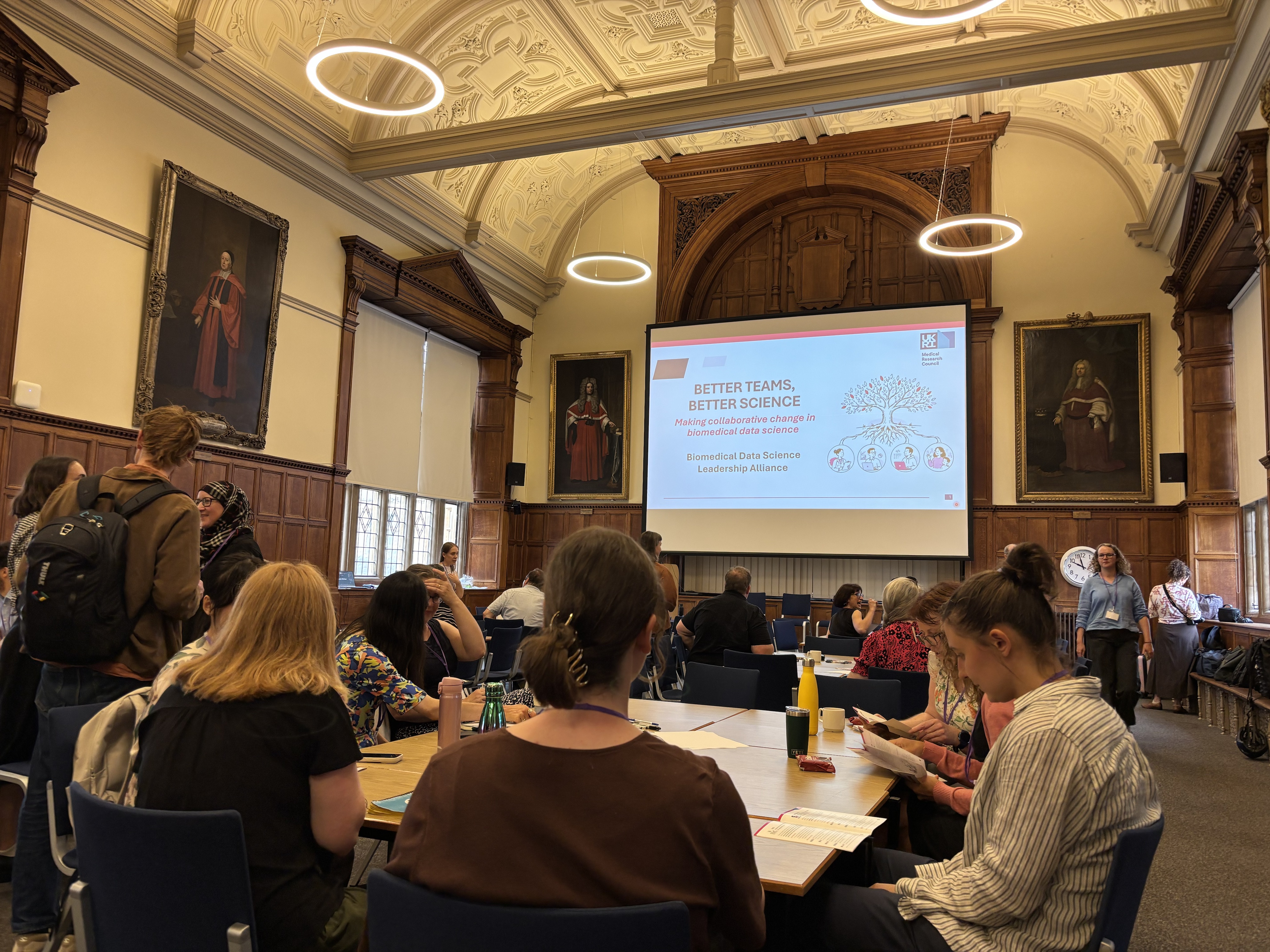
Better Teams, Better Science: Making Collaborative Change in Biomedical Data Science - 28th of July
by Eva Fernandez Amez
Last month, I had the opportunity to join our colleagues from the MRC Biomedical Data Science Leadership Awards in Oxford, for a full day exploring how we can build a stronger and more effective research culture within our teams.
The event brought together evidence and experiences from the projects funded through the programme, highlighting the challenges facing the biomedical data science community and some of the approaches being developed to address them.
Since I do not work directly in biomedical data science, I was not sure how closely this discussions would relate to the work we are doing as part of the Digital Research Infrastructure programme. However, as the day went on, I was surprised by how many of the challenges felt very familiar. Questions around skills, career development, recognition and collaboration are indeed not unique to biomedical data science - they are issues that we are also facing in our own community.
What Better Teams, Better Science made me think about
Before getting into some of my takeaways, it is probably worth giving a little bit of context about the programme.
The event started by looking at some of the challenges identified in the MRC’s 2022 report, “The Opportunity of Biomedical Data Science”. These ranged from a fragmented research ecosystem and unclear career pathways to inequalities in participation and research cultures that do not always make collaboraion easy.
The Biomedical Data Science Leadership Awards (BDSLA) are tackling these challenges across five main areas:
- Training & Careers
- Equity, Diversity & Inclusion
- Reward & Recognition
- Cross-sector Working
- Team Science & Research Culture
Five projects hare currently part of the programme:
- ABDC (Advancing Biomedical Data Science Careers)
- BIOMEDASA (Biomedical Data Science Accelerator)
- HxC (Healthier Science through Collaboration)
- INTEGRATE (Embedding a supportive culture for data science in biomedical research)
- PROMOTE (Porgressing routes and opportunities through mentoring, openness, training and equity).
The opening talk from Eva Caamaño Gutiérrez brought all of this work together, giving us an overview of what the different projects have been exploring and, most importantly, what they are already learning from it. As mentioned, there was a lot covered during the day, but a few things in particular caught my attention:
Interdisciplinary science does not happen by accident.
Working across disciplines can lead to better research, but it also requires time, communication and coordination that are not always properly recognised or resourced.
BIOMEDASA found that 85% of clinical researchers considered data science extremely important, yet more than 90% reported having no dedicated data science support. Even when data specialists are involved, they are often brought in too late and asked to solve problems without having been part of the original decisions. For me, it was a good reminder that interdisciplinary research isn’t just about having the right people in the room, it’s about having them there early enough to make a difference.
The challenges and opportunities start earlier than we may think.
BIOMEDASA highlighted that there is a 1:4 ratio of girls to boys choosing Computing at GCSE level, alongside wider challenges such as a lack of suitable computer rooms and IT equipment. It was also encouraging to hear that targeted interventions during children’s formative years can significantly increase their confidence and understanding of basic coding concepts.
These challenges continue later in people’s careers. PROMOTE found a clear difference in reported experiences of workplace EDI issues, with 31.6% of female university respondents reporting these challenges, compared with 5.1% of male respondents. INTEGRATE highlighted some of the barriers behind this, including caring responsibilities, short-term contracts and unequal administrative workloads.
Talent is widely distributed. Access to opportunities, recognition and participation is not
Training is important, but it cannot compensate for teams and career structures that are not properly designed to support people. INTEGRATE found that 65% of biomedical data professionals face barriers to accessing training, while 77% want more career workshops, 68% want wider peer networks and 51% would like opportunities for industry secondments.
Recognition is another issue. More than 85% of those interviewed felt valued by their immediate teams and managers, but this dropped to around 57% when considering their departments and the wider community. Recognition can fade with distance from the work, making visibility and career progression more difficult. There is also a question of whether data-science contributions are recognised fairly. BIOMEDASA shared feedback: “Despite doing all data analyses, figures, writing of methods, results and some of discussion there is still question about authorship”. ABDC similarly highlighted: “The iterative process in data science is cognitively demanding and not always recognised, with some still perceiving it as just clicking buttons”.
What solutions can work?
Of course, the event wasn’t just about identyfing the problems. It was also a chance to see more of the practical work already being done to address them.
One example that particularly caught my attention was the competency mapping. By bringing together existing frameworks, the project has developed a set of minimum standards for biomedical data science, helping organisations think about the skills they need and giving individuals a clearer idea of possible career paths and skills gaps. Explore the competency hub here
There were also some really practical resources being developed around interdisciplinary working, like the CPD-accridted, 11-course video training programme, covering topics identified through stakeholder research and co-produced with ECRs, industry, patients and the public. The Team Code of Conduct Toolkit takes a different practical approach, using activities to help colleagues understand how others in their team think and work. Check these resources here
Imagining the blue sky
Later in the day, we took part in an activity called “The Roots and the Blue Sky”, where we were asked to imagine what better teams, better science could look like. It was a nice way of bringing together many of the themes from the day: recognition, career development, inclusion, collaboration and research culture.
For me, one of the interesting questions was not just “what skills do we need? ”, but “what kind of environment do we need to create for those skills to have an impact? ”. Having a technically skilled workforce is important, but it is only part of the picture. People also need opportunities to collaborate, build networks, develop their careers and have their contributions recognised.
Better teams are part of better science
I left the event thinking about how closely many of these conversations connect with CAKE and all the other DRI projects. At the end of the day, it is clear that people are at the centre of the research ecosystem. Skills and training matter, but so do the communities, career pathways, working environments and opportunities that allow those skills to be used effectively.
A big thank you to everyone who organised Better Teams, Better Science and to all the speakers and participants who shared their experiences and insights throughout the day. It was a really interesting and thought-provoking event, and I’m glad I had the opportunity to attend and represent CAKE!