Thinking about the future of equitable open research
The history of open research spans many decades and has been bolstered by global milestones, like the UNESCO Recommendation on Open Science. The Recommendation sets out six principles around transparency, equality, responsibility, collaboration, flexibility and sustainability. In the UK, expectations of open research are also increasingly becoming embedded in research practice. In this context, came the UK Reproducibility Network’s Open Research Programme (to develop institutional skill, capacity and reward for open research practices), funded by Research England, which draws to a close in August next year.
This year, 2026, is therefore a perfect opportunity to engage with colleagues from across the globe to navigate what’s next for UKRN as well as consider the broader future of open research.
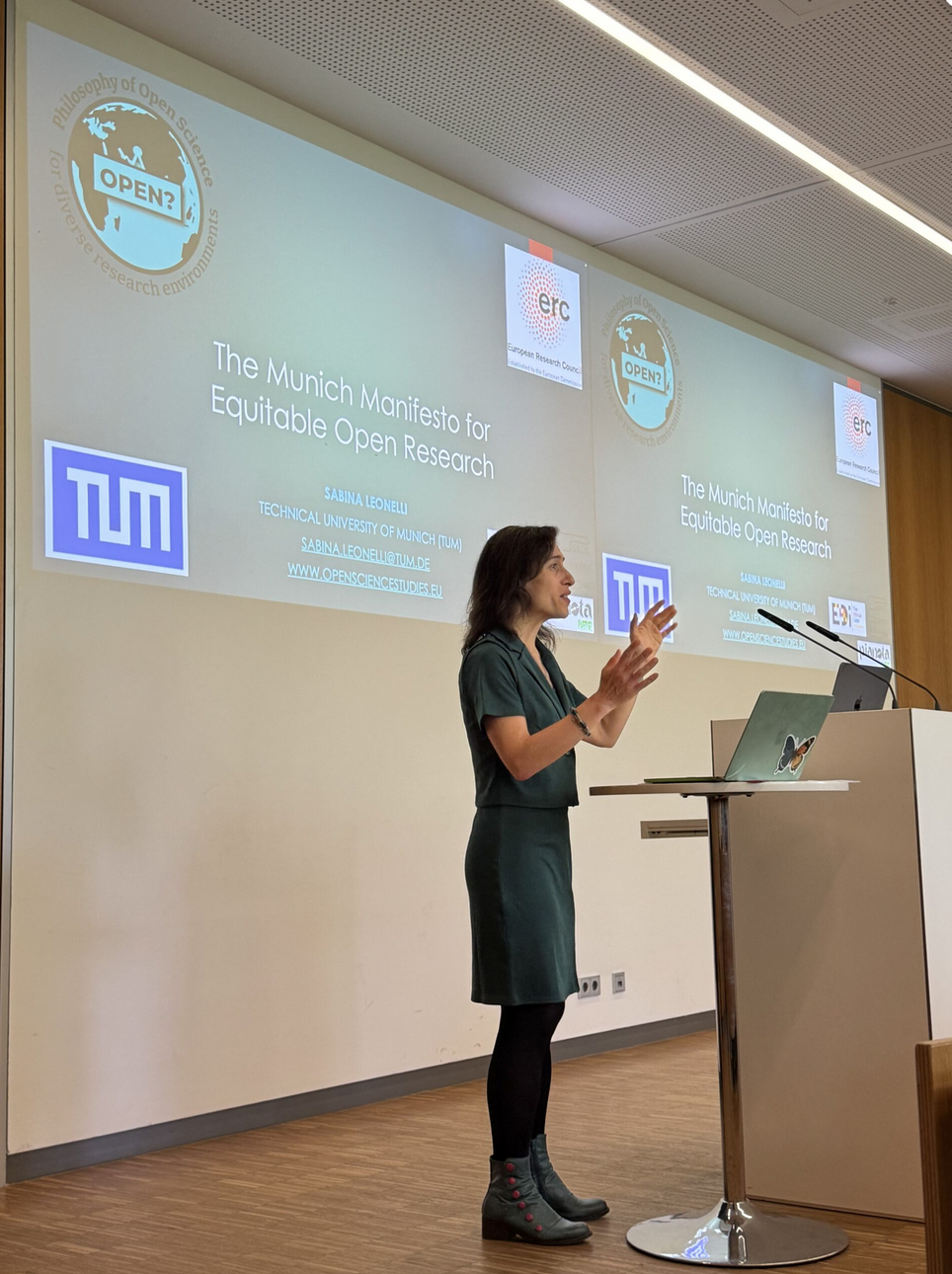
The Future of Open Research conference 2026 was hosted by the PHIL_OS project led by Prof. Sabina Leonelli at Technical University of Munich in Munich-Garching this May. The conference was split across the themes of infrastructures, data sharing and management, participation and engagement, scholarly communication and metrics and had a thread of equity and justice running throughout. Ruth Davies, Kings College London and I (Alice Howarth, The University of Sheffield), saw some common focuses developing during the event, with a strong focus on building judicious connections, balancing intention and principle with practice, avoiding end user-isation and working towards process-oriented practice (rather than object-oriented).
We had the opportunity to discuss with colleagues the importance of open research as it sits within the wider research context and the risk of reproducing flawed assumptions, the consequence of particular business models, the concerns around value extraction and the (potentially artificial) urgency presented by AI.
Ruth and I are particularly interested in how open research can contribute to the development of reliable, responsible and equitable research. In particular, we are interested in the question: is open research itself is an exemplar of reliable, responsible and equitable practice, or does it reproduce the culture of the research ecosystem it sits within?
In the second plenary panel of the conference, with Louise Bezuidenhout, Tony Ross-Hellauer, Barbara Prainsack, Antonia Schrader, Rachel Ankeny and Aleksandra Lazić we heard considerations on the implementation of equity and justice in open research. This panel raised questions about the equity of open research, identifying issues in a culture which encourages those in lower-middle income countries to ‘catch up’ rather than being included at the foundation. There was a strong theme that the right voices have not always been in the room, and if they are in the room, the discussion is not always held as equal partners with the goal to learn from wider experiences. There was an acceptance that many who advocate for open research are enthusiastic about equity, but that funding structures and national mandates aren’t always geared towards it. Moreover, there was a message that we should challenge the idea that open research is the mechanism for equity, and that we must commit to a diversity of input to design more equitable systems.
These themes are perhaps why the conference was held, in part, to shape and finalise the Munich Manifesto for Equitable Open Research which sets out that “urgent global challenges demand transnational cooperation, placing the value of intelligent strategies and formats for [open research] beyond doubt”. The Manifesto outlines that “[open research] initiatives risk amplifying dangerous forms of discrimination in the production, use, and evaluation of knowledge, thereby damaging the research system instead of delivering improvements” and sets out five key priorities to “ensure responsiveness to both global needs and local perspectives” which are – diversity, resilience, engagement, justice and honesty.
In our own context, Ruth and I have been leading the UKRN Open Research Programme’s consideration of the equality impact of open research work. We have developed five project Equality Impact Assessments which serve as an ongoing tool to identify impact and develop practice to enhance inclusivity, diversity and equality across the programme. We shared our process through a poster at the Future of Open Research in May which can be viewed at the UKRN’s Hub on OER commons.
The Future of Open Research conference was a timely opportunity for Ruth and I to develop our thinking on the topics of equity and open research and use some of our learnings to shape the next steps for the UKRN’s Open Research Programme.
by Alice Howarth, The University of Sheffield
- Read more about Alice and Ruth’s CAKE Placement & Visit, as well as other experiences, here.
- Learn more about and apply for your own CAKE Placement & Visit here.
[Photo source: https://opensciencestudies.eu/for-2026-conference/gallery/]